
The Waiting Game: Peer Review vs. Implementation Science
Peer-reviewed journals move carefully, and often slowly. Hospital floors do not.
In maternal health, the gap between publication timelines and day-to-day operations is not academic. It shows up as emergency visits, readmissions, and preventable suffering in the weeks after birth. The question is not whether evidence matters. The question is what happens while everyone waits for it to arrive.
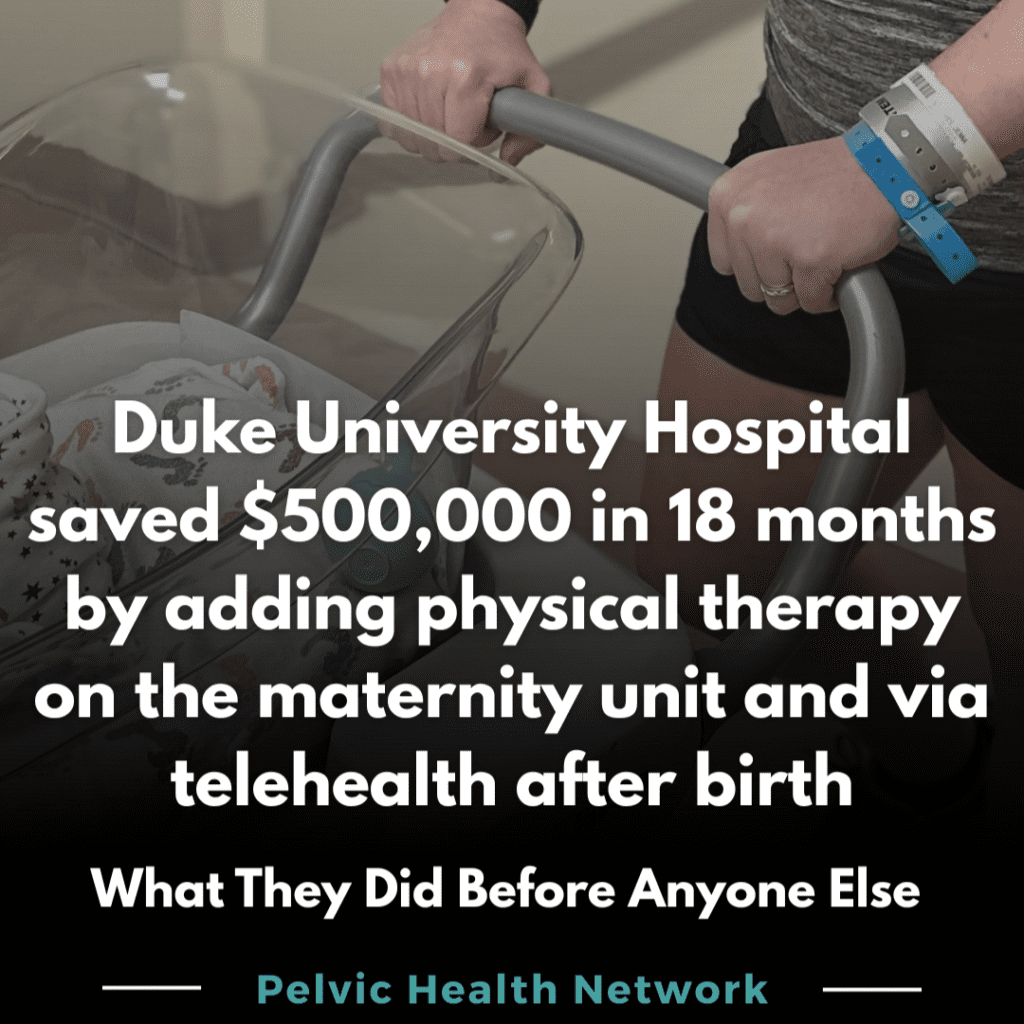
At Duke University Hospital, the shift began with a single patient. She asked for bedside pelvic floor physical therapy during her postpartum stay, describing a level of in-hospital support she had received in another country. Her request did not land as a customer-service add-on. It became the starting point for a quality improvement effort that treated postpartum recovery as a unit-level workflow problem, not a six-week follow-up problem.
The 18-month pilot that followed produced results that hospital leaders understand immediately: more than $500,000 in avoided costs, and postpartum readmissions dropping from an expected 126 readmissions to just 6 readmissions.
The work was led by a multidisciplinary team: Jennifer Thornton-Jones, PT, WCS; Amanda Heath, PT, DPT, WCS; Valerie Adams, PT, DPT, WCS; Lisa Massa, PT, WCS; Erick Fink, PT, DPT; Jennifer Bartlett, PT, DPT; and OBGYNs Dr. Clayton Alfonso and Dr. Angel Nieves. Their implementation focus was direct: integrate pelvic health-oriented physical therapy into routine postpartum care on the maternity unit, and pair it with structured early telehealth follow-up after discharge. Program details have been described in Duke Health sources, including the Academy of Pelvic Health Physical Therapy and Duke Obstetrics & Gynecology: https://www.aptapelvichealth.org/info/implementation-of-an-acute-care-ob-and-postpartum-telehealth-program-at-duke-health and https://obgyn.duke.edu/blog/duke-health-inpatienttelehealth-postpartum-pt-program-benefits-patients.
The Problem: Postpartum Readmissions, Low Percentage, High Volume
Postpartum readmissions are often treated as statistical outliers. National rates are commonly reported around 1-2%. In high-volume hospitals, even a low rate translates into substantial utilization.
At an average of 350 births per month, an 18-month period represents roughly 6,300 deliveries. At a 1-2% readmission rate, that range implies approximately 63 to 126 readmissions. Duke’s pilot used an expected count of roughly 126 readmissions.
The financial implications are direct. When a single readmission is estimated at $5,000 – $8,000 in cost, the cumulative exposure can reach hundreds of thousands to millions of dollars over a relatively short period, apart from the clinical and family burden of returning to the hospital soon after birth.
The Intervention: A Two-Part Postpartum Recovery Model, Built to Scale Without Creating New Bottlenecks
The pilot was not built around additional discharge education alone. It emphasized service delivery, access, and a staffing plan designed to avoid predictable failure modes. As part of implementation, Duke created a distinct referral order: Physical Therapy Postpartum Evaluation and Treat. The aim was to distinguish pelvic health focused postpartum care from standard mobility-based inpatient physical therapy.
Program leaders described a strategic pivot early in implementation: training outpatient staff first before broadening inpatient demand, so that new referrals would not immediately translate into a destabilizing waitlist spike. The design aimed to expand capability in parallel with demand rather than after the fact. In later scaling, Duke reported that nearly 60 physical therapists have been trained to focus on maternal medical risks and musculoskeletal concerns.
The model included two core components, with clear program goals: inpatient access to pelvic health specialists; telehealth follow-up to strengthen the continuum of care; and earlier identification of postpartum issues that commonly surface after delivery, including coccygodynia and pelvic organ prolapse.
- Inpatient Physical Therapy and Occupational Therapy: Pelvic health-oriented rehabilitation integrated on the maternity unit during the postpartum admission.
- Early Telehealth Follow-Up (Two Weeks Postpartum): A structured two-week postpartum telehealth program designed to meet ACOG guidance on early maternal touchpoints and to identify issues before they escalated into urgent care or readmission. The follow-up included use of the AWHONN Post-Birth screening tool to identify red flags requiring escalation.
The operating premise aligned with enhanced recovery frameworks used elsewhere in acute care: major physiological events trigger early mobility, symptom management, and functional support, rather than deferring care until a six-week follow-up window.
Related coverage and resources: pregnancy and postpartum care
Results Reported: Readmissions Fell From an Expected 126 to 6
Internal program data was presented publicly by Lisa Massa, PT, CLT, program coordinator for Duke’s Women’s Health Physical Therapy Residency, at the 2025 Combined Sections Meeting of the American Physical Therapy Association.
Key figures reported:
- Expected Readmissions (18 months): 126
- Observed Readmissions During the Pilot: 6
If readmissions avoided are calculated as 120, and the cost per readmission is estimated at $5,000 on the low end, the avoided-cost total reaches $600,000. Duke described the results as exceeding $500,000 in avoided costs over 18 months, reflecting conservative assumptions and/or varying cost attribution.
Implementation Science vs. Publication Timelines
Peer-reviewed evidence remains foundational for clinical standards and payer policy. Implementation science addresses a different question: how to deploy plausible, low-risk interventions within real systems, measure outcomes quickly, and refine operations based on performance.
The Duke pilot illustrates a model of transparency that matters to other hospitals: sharing unit-level results, defining interventions clearly, and quantifying financial impact in terms administrators can evaluate alongside safety and experience metrics.
Access Gap: Only 127 U.S. Maternity Units Report Inpatient OT/PT Postpartum
Despite growing discussion of early mobility and pelvic health rehabilitation, inpatient OT/PT during the postpartum admission remains uncommon. Pelvic Health Network’s directory work indicates 127 maternity units in the United States provide occupational and physical therapy services postpartum during the hospital stay. Duke University Health System accounts for two of those sites.
For hospital systems, the barrier is frequently structural rather than clinical: staffing models, referral pathways, and default postpartum workflows that treat functional recovery as optional rather than standard.
Hospital implementation support: hospitals
Patient Experience and Workforce Impact
Financial results are only one dimension. The program’s authors, Valerie Adams, Amanda Heath, Lisa Massa, and Jennifer Thornton-Jones, described success as a combination of measurable utilization outcomes and the qualitative signals that determine whether a service becomes durable. In Duke Health reporting, Dr. Clayton Alfonso emphasized a consistent message from patients: they wanted early access to help them meet goals at home. He also described the two-week touchpoint as a practical checkpoint that can catch early warning signs of other postpartum concerns.
In practice, performance was evaluated through two lenses:
- Financial impact: readmission rates and associated cost avoidance.
- Patient and nursing feedback: whether patients reported improved confidence and function, and whether nursing teams experienced reduced strain as mobility, positioning, and functional education shifted into a rehab-led model.
Those experience measures, reported alongside the readmission data, were positioned as essential to sustaining leadership support and scaling the workflow beyond a limited pilot.
What the Duke Case Suggests for Postpartum Care
Duke’s results indicate that postpartum rehabilitation can be evaluated as both a safety intervention and an operational strategy. For hospitals under pressure to reduce utilization while improving experience, inpatient rehab and early follow-up represent a testable, measurable pathway. The point is not to replace peer-reviewed evidence. The point is to avoid letting publication timelines delay operational changes that reduce harm and cost.
Duke’s results are the point of the story: a hospital team that stopped waiting for permission to test an early recovery model, measured what happened, and put hard numbers to the outcome. Implementation science exists for that gap.
Pelvic Health Network tracks early recovery models and the clinicians and hospitals implementing them, with the goal of shortening the time between discharge and meaningful functional support.
Learn more: Pelvic Health by Design
Summary of Duke’s Impact (reported):
- Volume: 350 births per month
- Problem: postpartum readmissions estimated at $5,000 to $8,000 each
- Intervention: inpatient PT/OT plus early telehealth follow-up
- Result: expected 126 readmissions vs 6 observed during the pilot
- Savings: reported as over $500,000 in avoided costs over 18 months
- Operational frame: implementation science, rapid-cycle measurement, scalable workflow design