
By Rebeca Segraves, PT, DPT, PWCS
Postpartum Physical Therapy During Hospital Admission in Dubai
Dr. Clayton Alfonso, MD is an OB/GYN at Duke University Health System.
One of his patients had previously delivered a baby in Dubai. When she came to Duke to deliver her next child, she told Dr. Alfonso that a physical therapist treated her in her hospital room after she gave birth in Dubai. She wanted the same experience at Duke.
Dr. Alfonso wasted no time. He consulted with the Duke Women’s Health Rehabilitation Team. After making it clear he didn’t want the pelvic health team to have any increased wait times, the team made a plan.
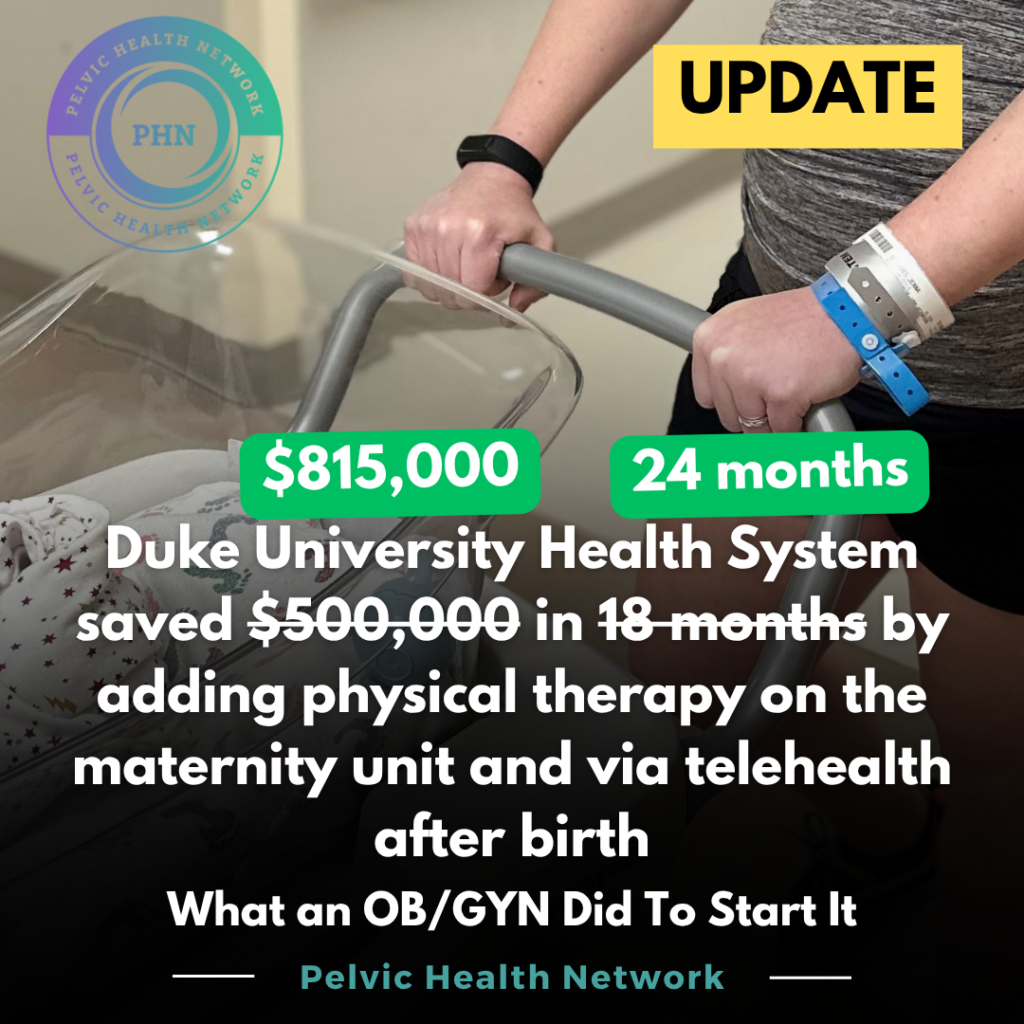
They developed an internal training for outpatient ortho therapists to treat pregnant and postpartum patients. That expanded the department from 25 pelvic floor therapists to 82 pelvic and MSK therapists equipped to treat pregnant and postpartum patients across the continuum of care.
That gave the team the capacity to place pelvic health physical therapists on the maternity unit and provide telehealth coverage in the first two weeks after discharge.
On the unit, therapists treated mothers within hours of delivery. Perineal tears. C-sections. Operative vaginal deliveries. High pain levels. Difficulty voiding. Lower extremity edema. MSK concerns. High-risk pregnancy admissions. Mothers stepping down from the ICU. And mothers who simply asked to be seen.
During telehealth visits in the first two weeks after discharge, therapists screened for high blood pressure, infection, postpartum depression, signs of stroke, and more. Every positive screen went directly to OB triage.
The Results of the “Duke Outlier”
Across 2,499 telehealth visits, therapists identified 268 red flags.
Duke projected 168 hospital readmissions over 24 months. Only 15 occurred. The OB rehab program saved their health system $815,000.

The arguments most often made against this model of care is that Duke is an outlier. They have telehealth infrastructure most hospitals don’t have. They scaled from 25 to 82 therapists. They had resources and physician champions most systems don’t have yet.
Those arguments are all true. And they are all missing the point of what research is for.
Research doesn’t exist to tell you what your hospital can replicate today. It exists to raise the floor. To show what’s possible when an institution decides that discharging a mother after major surgical birth without a rehab evaluation is no longer acceptable. To give every clinician, administrator, and physician in a smaller system, the language to walk into a meeting and ask: why aren’t we doing this?
You don’t need telehealth to start. You don’t need 82 therapists. You don’t need $815,000 in projected savings to justify the conversation.
You need one physician willing to ask the question that Duke asked before the data was in: What would happen if we stopped sending mothers home without a rehab professional seeing them first?
The International Floor
Duke is the ceiling. Not the floor. The floor is the question.
And that question matters because other countries answered it years ago. They established postpartum rehabilitation as part of routine care, not as an experimental add-on and not as a luxury available only in unusually resourced systems.
- France: Every woman has had access to a minimum of 10 postpartum physiotherapy sessions since 1985. It’s called la rééducation périnéale. It’s covered. It’s standard. Nobody debates it.
- United Kingdom: Multiple NHS hospitals have physiotherapists on the maternity unit before women leave the hospital. It’s a standard of care there too.
- Australia: The Women’s and Children’s Hospital in Adelaide endeavors to provide an individual physiotherapy consult to every mother who delivers her baby there.

The U.S. Gap
In the most expensive healthcare nation in the world, we are still debating that a randomized controlled trial is needed before we offer rehab to women after childbirth despite the fact that several countries have already figured this out.
We’ll get there. France only had a forty-year head start.
Physicians took an oath to do no harm. Our insurance model did not take that oath. “First do no harm” in the U.S. comes with a prior authorization requirement.
We offer rehab after joint replacement. After stroke. After cardiac surgery. After spinal fusion. After ACL reconstruction. After hip fracture. After amputation.
A woman has her abdomen cut open to deliver a baby. We give her a pamphlet.
We schedule a follow up in six weeks.
We send her home.
Sometimes with an abdominal binder.
And in our top maternity care centers, she’ll get one even if insurance doesn’t cover it.
Acute care therapists treat patients after massive transfusion protocols following hemorrhage…just not postpartum hemorrhage.
Activity modifications are given to patients with hypertensive disorders and cardiac concerns.…just not preeclampsia. Even when she has a toddler, a newborn, and is managing single parenthood at home.
Incision protection strategies are standard after major surgery…just not after C-section. Even when she is going home to care for a baby, care for herself, on little sleep, and with pain medication.
But don’t fret. We’ll have the evidence soon on early rehab after birth.
We just need a few more postpartum readmissions to power the study.

The Duke Roadmap: How to Implement a Physician-Led Postpartum Recovery Program
- Physician leadership must ask: “What would happen if we offered mothers a consult with an occupational therapist and/or physical therapist within the first 0-2 weeks after birth?”
- Internal training in rehab settings can bridge the gap between what outpatient ortho therapists need to learn to treat pregnant and postpartum patients, which is the model Duke used to expand from 25 pelvic floor therapists to 82 pelvic and MSK therapists.
- Hospitals can pilot programs that place therapists directly on the maternity unit within the first 24-48 hours of birth to offer early recovery care after any delivery experience or during high-risk pregnancy admission to reduce functional limitations after birth.
- Early telehealth rehab in the first two weeks after discharge can help any system screen patients for red flags and streamline care back to OB triage.
Conclusion
Duke is an outlier. That‘s the whole point.
This is not a celebration of one exceptional system. It’s an indictment of how low the current standard remains. Duke is the ceiling because we have not yet built the floor for early rehab after birth.
The floor is not complicated. Other countries already established it. The United States has the evidence, the clinical expertise, and the surgical parallels in every other field of rehab. What remains is the decision to stop treating postpartum recovery as optional.
For hospitals and clinicians looking for existing postpartum recovery programs and models, review the hospital directory to find facilities advancing pelvic surgery rehab, women’s health, and early recovery after birth.