Rebeca Segraves, Editor
For years, the education provided to pelvic health therapists followed a rigid and conservative script. We were trained to believe that the body, particularly after the trauma of childbirth or surgery, is a structure that requires careful guarding. As a residency-trained pelvic and women’s health physical therapist, I spent a significant portion of my career teaching patients how to protect themselves. I focused on the internal pelvic floor assessment as the ultimate diagnostic tool. I instructed women to perform Kegels before every sneeze. I taught them to activate their transverse abdominis before standing up from a chair. I taught the log-roll technique was the only safe way for getting out of bed to avoid strain on the core after pelvic surgery.
I believed my pelvic floor training was the Gold Standard of care. It was a sequential, protective, and highly controlled method of rehabilitation. However, I have recently come to realize that this traditional framework may have inadvertently kept my patients small. By emphasizing limits and warnings, I was effectively teaching them to be afraid of their own bodies. I was creating a mindset of fragility rather than one of strength.
The Gold Standard That Kept People Small
The traditional model of pelvic health rehabilitation often begins and ends with the internal assessment. Many clinicians believe that without this digital examination, no valuable information can be gathered. Furthermore, many suggest that digital health options or telehealth services are inferior because they cannot replicate this invasive test. Consequently, a culture of gatekeeping has emerged in the industry. Patients are told that they must wait on long lists for specialized appointments before they can return to the activities they love.
Notably, the internal assessment is performed while the patient is lying down. It is a non-functional measurement. It does not account for how the pelvic floor responds when a person is standing, running, or lifting a child. By focusing so heavily on this single data point, we often ignore the broader context of a person’s ife. We dictate their behavior based on a subjective measurement of “weakness.” In fact, this focus on isolation can lead to a belief system where the patient feels “broken” unless a professional “fixes” them.
I practiced this way for a long time. I believed that every patient needed to master diaphragmatic breathing and deep core contractions in a supine position before they could even consider high-impact exercise. I kept them on the treatment table for weeks. I was hesitant to bring them into the gym. I was afraid that if they jumped or lifted something heavy without my specific cues, they would worsen their injury. Looking back, I see that I was not just a facilitator of healing; I was a gatekeeper who held them back from their full potential.
The Experiment That Changed Everything
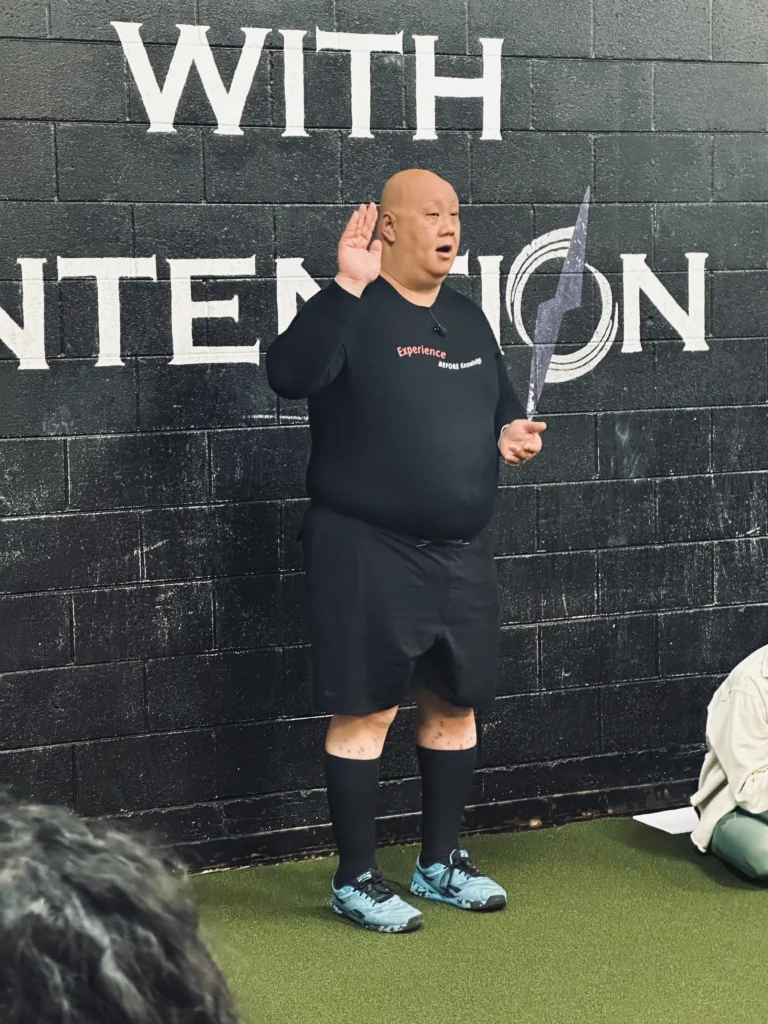
My perspective shifted during a continuing education course led by Antony Lo. During the “Female Athlete Level 1” course, I was forced to sit with a difficult question: Was I helping my patients, or was I making them more afraid? The answer became clear during a simple physical demonstration.

Antony used me as an example for an experiment involving an arm test. He asked me to raise my arm and resist him as he tried to push it down. He gave me no instructions other than to resist. I was strong. I held my ground with no difficulty. My body knew exactly how to stabilize itself without any conscious thought.
Next, he asked me to repeat the test, but this time he gave me a series of cues. He told me to contract my pelvic floor before he pushed. I focused intensely on those specific muscles. As I attempted to hold the contraction while resisting his force, he pushed my arm down with ease. My performance dropped significantly the moment I started over-thinking the movement.
He repeated the test with different cues. Every time he gave me something extra to think about, I became weaker. My body, which was perfectly capable of resisting him when left to its own devices, became clumsy and fragile under the weight of my own “expert” instructions.
This was a profound realization. Our words as clinicians matter more than we realize. Sometimes the cue we give before we even watch someone move is the thing that reduces confidence. We are often providing instructions for a problem that does not exist. By over-cueing, we are essentially telling the patient that their body does not know how to function without our intervention.

Redefining SCAR: Strong, Capable, Adaptable, Resilient
Historically, the word “scar” is treated as something negative in healthcare. We talk about reducing scar tissue or managing the restriction that a scar creates. However, Antony Lo created and teaches the SCAR framework as a more empowering philosophy. Instead of seeing a scar as a sign of injury, his SCAR principles guide practice through four ideas: Strong, Capable, Adaptable, and Resilient.
In Antony’s framework, the body is naturally strong. It is capable of incredible feats, including the massive physical transition of birth and surgery. Furthermore, the body is adaptable. It can learn to manage new loads and different types of stress. Finally, the body is resilient. It does not need to be babied or guarded indefinitely.
When we apply Antony Lo’s SCAR principles, our role as therapists changes. Instead of teaching people how to move “correctly” through a narrow lens of safety, we can help them “find the fence” of their capability. We need to explore the edges of what they can do. Research shows that strength changes occur when we train at over 70% of a person’s maximum capacity. If we always keep our patients doing low-intensity Kegels on a table, they will never see the functional strength gains they need for real life.
Moreover, we must stop treating the masses through a narrow field of one-on-one sessions only. There are not enough specialists to help everyone who needs it. If we insist that an internal assessment is the only way to get help, we leave millions of people without any support. We need to reach people where they are. We can teach groups. We can use digital platforms. Most importantly, we can teach people how to take ownership of their own health rather than giving that power away to a professional.


A Call to Action to Find the Fence
It’s time for a shift in how we approach early recovery after birth and surgery. We must move away from the fragility mindset that has dominated pelvic health for decades. We can stop assuming that every patient needs to be “corrected” or “fixed.” Instead, we can start by observing what they can already do.
One realization from this course has stayed with me in a very practical way. For years, I viewed the log-roll after a C-section as the first and only safe answer. Now I see that belief reflected a larger mindset in my own advocacy around hospital movement. I had been looking at the body through a lens of protection first, instead of capability first. I am rethinking that approach. When a patient gets out of bed after surgery, the more useful starting point is often to watch how they move, ask what feels okay in their body, and respond to what is actually happening. If they need support, support has value. However, the central message remains different for me now: their body is strong, capable, and adaptable in recovery.
This shift requires us to be humble as clinicians. We have to admit when we are getting in the way. We have to be willing to listen more and talk less. Indeed, it’s okay to publicly admit that our old ways of practicing might have been a disservice to our patients. Being willing to look inward is not a threat to our expertise; it is how we improve the quality of care for everyone.
For those seeking providers who understand the importance of early, functional recovery, the Postpartum Recovery Hospital Directory is a vital resource. This directory highlights healthcare systems that are leading the way in providing early access to physical and occupational therapy. These systems prioritize getting patients moving and feeling confident within the first few days of recovery.
Ultimately, the goal of rehabilitation is not to keep people in the clinic. The goal is to get them back to their lives. We must stop telling women they are broken. We must start showing them how resilient they truly are. By finding the fence of our own beliefs, we can finally help our patients find the fence of their own capabilities.
References
Lo A. The Female Athlete Level 1: Challenging the Status Quo [Course]. My PT Education. https://mypteducation.com/courses/the-female-athlete-course-level-1/.