


So why are we talking about leggings?
Because Lululemon understands something healthcare has forgotten: when the standard is audaciously high, you don’t have to beg for buy-in.
Right now, the standard for maternal recovery is to “wait six weeks” and hope for the best. But there’s a shift happening: early maternal rehab. This means bringing occupational therapy (OT) and physical therapy (PT) into the hospital room immediately after birth or pelvic surgery.
It’s about treating a C-section like the major abdominal surgery it actually is, starting on day one.
It’s about treating pelvic floor injuries earlier after birth to help women avoid lifelong issues of urinary incontinence, pelvic pain, and pressure “down there”.
It means bowing out of the song and dance with insurance companies who exclude far more than they insure.
Too much time gets spent apologizing for the cost of healthcare before the value is even shown. There’s no need to justify why early rehab exists for pelvic floor injuries when it already exists for an ACL tear. The real work is building postpartum recovery care so well that its worth is the most obvious thing in the room.
The Pediatrician’s Price Tag
Sometimes one patient changes the whole conversation. In this case, that patient was a pediatric physician.
She trusted her team. She understood her risk and exactly what a complicated post-delivery course looked like.
Then she went under. What began as a planned cesarean hysterectomy escalated into uncontrolled bleeding. Her recovery didn’t begin on the Mother-Baby Unit. It started in the ICU.

Her first postpartum visit with physical therapy focused on one question: Could she sit upright in a recliner? That was her ceiling. Not a long list of goals, not a polished discharge metric – just the hard reality of what her body could tolerate that day. She understood the anatomy of her long vertical incision. She simply could not make the transition to her bedside chair alone.
Over the following days, she progressed from there. First came standing straight. Then the first steps. Then a walk down the hallway. By the final visit, the focus had shifted to breastfeeding mechanics, specifically how to position her newborn so tiny feet stayed far from her surgical site.
Even with medical knowledge, status, and access, she still needed someone whose job was to show up for her recovery in a way the system had not planned for. The hospital understood that her true price tag wasn’t the cost of her therapy. It was the massive ROI of returning a skilled physician to her practice and securing the lifelong loyalty of a high-value decision maker who now knew the system would actually show up for her.
The Most Valuable Patient in the Building
Here is the part worth saying out loud: maternal health is not a side project. It’s not a sweet little specialty add-on. It contains the most under-treated surgical population in acute care, and at the same time, one of the most valuable long-term patient populations a health system will ever have.
The typical maternal patient is young, engaged, and at the beginning of years of healthcare decisions. She has just gone through a major physical event that demands real recovery. Yet in many systems, she remains the only surgical patient sent home without a clear rehabilitation plan. That gap does not stay small. It turns into long-term physical problems, psychological fallout, and a lasting memory of whether the system showed up when it mattered.

Patients remember this season with unusual clarity. They remember the people who helped, and they remember the systems that didn’t. When recovery is handled well, the impact goes far beyond healing. A mother becomes loyal to the system that cared for her. She brings her children there. She sends her partner there. She tells friends where to go. She writes the reviews. She becomes the reputation engine. Loyalty is built in the moments when care feels either deeply considered or painfully absent.
Positioning Versus Clinical Competency
Very few healthcare systems are building comprehensive programs for this population, and the reason is not a lack of need. It isn’t even a lack of clinical skill. The issue is positioning. Therapists often get stuck on where they fit in the hospital structure, how to secure the referral, or how billing works when both OT and PT belong in the room.
Those are real operational questions, but they are not the core problem. The core problem is that maternal rehabilitation is still being framed like an optional add-on instead of a standard. Lululemon did not become Lululemon by pricing itself like everyone else and hoping shoppers would notice the fabric. It set a standard first. Then the market followed.
Innovation Through Remote Monitoring
If the hospital stay is the high-performance product, then remote monitoring through telehealth is the seamless integration that keeps it running. This is the premium aftercare layer, the part that protects the hospital’s investment in recovery from falling apart the moment a patient walks out the door. Programs like Operation M.I.S.T. are pushing that standard forward by following patients at home, where complications often begin quietly and escalate fast. Vital signs and recovery metrics don’t stop mattering at discharge. In many cases, that’s exactly when they matter most. The systems that understand this are not treating remote monitoring like a tech add-on. They are treating it like infrastructure for an always-on standard of care.

Dr. Jenna Segraves, PT, DPT, NCS, a leading birth recovery advocate and co-founder of Enhanced Recovery After Delivery®, shared her own experience of a life-threatening postpartum gap with Dr. Katherine Sylvester on the Operation M.I.S.T. Podcast for a deeper conversation about what this model makes possible. The discussion is not about gadgets. It’s about a more intelligent form of maternal care, one that stays connected after discharge and catches danger before it becomes disaster. In that sense, remote monitoring is not extra. It is the continuation of serious care, and in the peripartum period, that always-on standard is already saving lives.
Redefining the Standard of Care
The future of maternal rehabilitation is not about making a case for why it should exist. It’s about making it so good, so smart, and so visibly useful that the argument disappears. The real question is not whether hospitals can afford to build this. The real question is which systems will be bold enough to build it first.
Clinicians in acute care are in a prime position to lead that shift. Early recovery, often well before the traditional six-week checkup, can change the trajectory for postpartum patients. It moves care away from the old “wait and see” model and toward something more responsive, more modern, and frankly, more honest about what recovery actually takes.
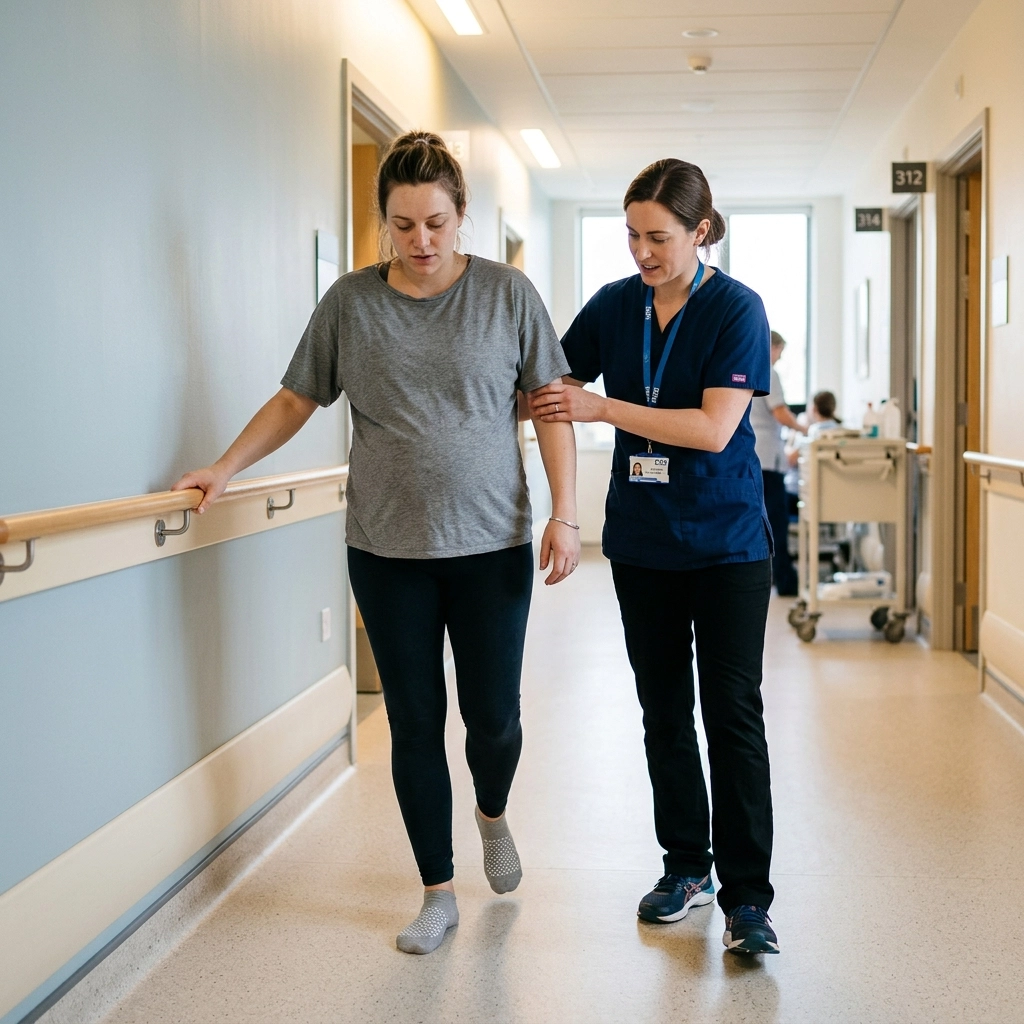
That standard includes the real mechanics of new parenthood: protecting a surgical site, learning safer ways to hold and feed a baby, gradually increasing activity, and connecting patients with specialists who understand early rehabilitation. It’s time to talk about building something audaciously valuable your patients will love.
Resources & Advocacy
For those ready to implement a new standard of care in early postpartum recovery, several resources are available to guide the development of high-quality service lines:
- Hospital Directory: A comprehensive list of facilities offering specialized OT and PT services after birth.
- Operation M.I.S.T.: Advanced remote monitoring to support maternal health and prevent complications.
- Cesarean Rehab Workshop: Evidence-based training for rehabilitation professionals focusing on early recovery.
If you are an acute care or maternal health therapist, it is time to stop focusing solely on billing codes and start focusing on building something that is audaciously worth it. The patients are already in your building. They are waiting for a standard of care that matches the significance of the life event they have just experienced.